

Agency life can feel like one battle after another. AI is revolutionizing the professional services industry, and wider economic uncertainty makes finding and retaining new customers more challenging than ever. According to Promethean Research, the average agency registered 7.5% revenue growth in 2025, but also cut staff by 2%, and saw margins slip to 13% from 14% the previous year. So what can agencies do to proactively steady their ship?
Managing scope creep is a great place to start. According to research by Ignition, a pricing and payments application used by agencies, 78% of agencies say they rarely or only sometimes charge for scope creep. This means 57% of agencies lose between $1-5k each month doing out-of-scope work, and 30% of agencies are losing over $5k. Almost all agencies (87%) are therefore losing anywhere from $12k to over $60k each year by failing to address scope creep.
The good news is that AI agents can now help combat agency scope creep in ways that would previously have been impractical, or unjustifiably expensive. In this article we'll explain how to use AI agents to manage scope creep at every step in your project workflow. If, like 28% of those surveyed by Ignition, you're selling subscription-based rather than project-based services, these tips are equally relevant, and can be implemented in an ongoing manner.
Scope creep conversations are some of the most delicate you will ever have with partners, and AI will never replace the long-term, trusting relationship you build with your clients. But AI can help you spot details you or your team might miss, and give you flexibility, suggested strategies, and operational capabilities you've probably missed before.
Here at Supernormal, we make agents designed to help agencies thrive, and the recommendations made here are informed by that work. However, these guidelines are designed to be useful whichever tools and agents you choose.
Agency workflows: Where scope creep can occur
Your agency likely has a proprietary workflow developed from experience working with your specific clients and area of specialism. Workzone's workflow map is broadly applicable to all types of agency however, and in this article we'll breakdown where agents can help at each stage of this high-level framework:
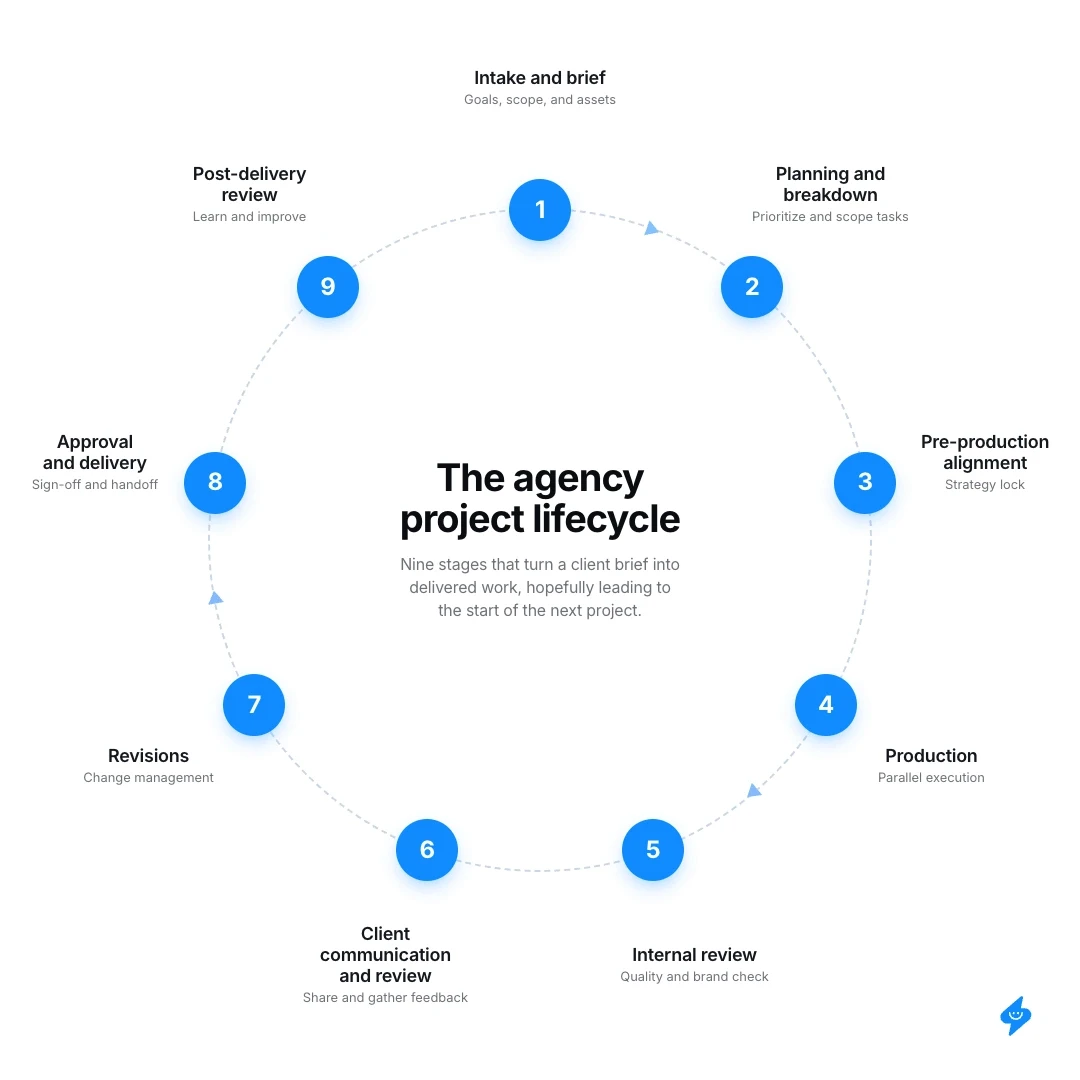
Intake and brief
Planning, prioritization, and task breakdown
Pre-production alignment (strategy lock)
Production (parallel execution)
Internal review
Client communication and review
Revisions and change management
Approval and delivery
Post-delivery review and improvement
If you're working with clients on long-term retainer, this model is still relevant, repeating regularly and with some steps occasionally skipped.
1. Intake and brief: Laying the foundation for a clear scope
When you first engage with a client, their expectations, and therefore the scope of the project, are typically communicated via multiple channels and in varying formats: Email, documents, meetings, briefing decks, budget spreadsheets, Slack messages. The opportunities for mismatched expectations and scope creep start here. Agents excel at collating and summarizing information from multiple sources, so at this stage it's important to feed the rich context you receive to a client-specific agent, even if you don't need the agent to take action (yet). The agent can then reference this information throughout the project, checking for scope creep, as well as upselling opportunities, and contradictions in what the client is telling you, or mismatches between ongoing work and client expectations.
Most crucially, all meeting context should be provided to your agent at this stage. Discovery and briefing calls, or even networking chats or catch-up coffees from last year, are a primary source of information about what the client really wants and needs from the engagement, beyond what they provide in official briefing documents. Make sure transcripts and meeting notes are also captured.
Not all clients provide sufficient information on their expectations at this stage. Great agencies excel at helping document client expectations and checking they have understood these. Agents are also well suited to creating the first drafts of this documentation. Clients feel heard and understood, you save time on document formatting, and no detail slips through the cracks. Try using Supernormal's Campaign Brief and Creative Brief presentation templates for example, to turn a discovery or briefing call into a beautifully-formatted deck with the help of our agents.
2. Planning, prioritization, and task breakdown: AI-powered project planning to ensure nothing is missed
Once objectives and high-level deliverables are clear, the next step is to plan how the work will happen. Again, AI agents are ideal for getting this work started. Whatever project management tool you use, and whatever visualization best helps your team, be it Kanban, timelines, dashboards, or tickets, agents help you speed up this step, turning the context you've provided into drafted plans for you to review, tweak, and feed into your project management tools.
Later deviation from these plans will be your first hint that scope creep may be happening, and using an agent at this stage ensures alignment with all the information you inputted in stage 1.
For more information on how to use an agent to manage a project, read our article on managing projects with an AI agent.
3. Pre-production alignment: The yardstick against which scope creep will be measured
Most clients aren't intentionally trying to increase scope, they're just excited about the work and reiterating their needs. It's natural for circumstances to change, exact needs to become clearer once they see initial drafts, or just to always want a little more. Generally, requests for scope creep are a good sign. The client likes what you're doing, and wants more of it. At this stage, frame a clear scope as the client's insurance policy, to ensure their project comes in on time and on budget.
The document signed off by the client at this stage will be the yardstick against which future scope creep will be measured, so if changes are requested at this stage, make sure they are documented. This step is often marked by a final alignment meeting, so ensure the meeting transcript and any supporting documents are again supplied to your agent, as well as the client and team. Often, your AI agent will be better than you are at spotting deviations from this document later down the road.
This is also a great moment to ask your agent to check for misalignment between the final alignment documentations, client conversations, and earlier project details. You may have missed these in the normal back-and-forth and high-level strategy conversations, but your agent won't have. For more information on turning client calls into a clear record of what was agreed, see AI and meetings: How context changes everything.
4. + 5. Production and internal review: Agents against unintended scope creep
As you work on deliverables, scope creep may happen because of team ambition, and well as client requests. At this stage, use your agent to check outputs against agreed scope and client objectives. Sometimes the agent may spot misalignment better than the people who are heads-down and absorbed in actually doing the work.
Once the work actually starts, plans may also need to be constantly adjusted. This can create a lot of manual work, adjusting plans, tickets, and documentation. Agents can speed up a lot of this admin work, freeing up time for the creativity and strategic excellence the client is paying for.
6. + 7. Client communication, revisions, and change management: Using AI to spot scope creep, and proactively suggest solutions
This is the stage at which some of the most challenging scope creep conversations occur. The client sees the deliverables, even if they’re still just in draft, and starts requesting something more, or something different. The challenge shifts from spotting scope creep to managing it.
The human relationship between you and your client can never be outsourced to an agent. But the delicate business of reinforcing boundaries, suggesting possible solutions, or even upselling, can be supported by an agent who should be well-informed on the details of the project by now. When you or your agent identify project scope creep, brainstorm a variety of solutions with the agent. There may be creative approaches to rethinking the project structure that you haven’t considered. Have the agent draft a variety of options for adjustments to existing plans, like reducing the scope of one workstream to expand the scope of another. Or even use the agent to structure optional additional services that the client may now be interested in.
Any project adjustments at this stage can be laborious, and an AI agent can re-draft budgets, craft slides explaining changed, or even adjust the wording in a contract, so you can focus on review and client comms. Remember that scope creep at this stage is often a good sign that the client is fully engaged with the work, and may even be open to upselling or extending the scope of the project.
8. Approval and delivery: Agents for upselling in a best-case scenario, or protecting you when things didn't go to plan
Congrats! You've reached the finish line of the project. You've likely been holding your breath until that final delivery meeting is completed, and the client is totally satisfied. If the client is broadly happy, this is the time to proactively look for opportunities to expand the work further, and start again at stage 1, this time with an agent by your side that has all the context from the successful first project. As you and your agent structure these new project options, ensure your agent has access to emails, Slack threads, and the notes from final client handover meetings. Opportunities may be hiding in a throw-away comment you missed while trying to get the project over the line.
What if this client is less than happy? If their dissatisfaction is related to perceived underdelivery, all that documentation from the early stages of the project will be crucial to grounding conversations in facts and specifics, and looking for mutually acceptable solutions. Again, an agent may see options you might not have considered, so treat them as a thought-partner to support you at this stressful time. The agent will also be able to pull specific details and exact quotes from meetings, acting as an important line of defense if you need it. For advice on spotting early warning signs so this situation never comes as a surprise, and a basic protocol for communicating with unhappy customers, we like this guide to handling unhappy clients from The Admin Bar, a community for agency owners and freelancers.
9. Post-delivery review and improvement: Agent as team coach and institutional memory
Now the project is over the line, it's tempting to move on with the next piece of work, but outstanding agencies always take a pause to learn from what just happened. Agents make excellent coaches at this stage, including reflecting on where scope creep did happen, and how this might be prevented in future. Try asking your agent the following questions:
Where did our work deviate from the originally agreed plan?
How might I have better managed the project?
Looking specifically at the emails/Slack messages/meeting transcripts associated with this project, how can I improve my client communication skills?
Practically, you can also ask the agent to draft team de-brief exercises, or retro surveys.
Project packaging and structure can also be at the root of sub-optimal project outcomes, and now is the time to analyze learnings about that from this particular project. Work with your agent at this stage to consider alternative service bundles, more efficient or standardized scopes across projects, or making a move to subscription packages that can make cash flow and staffing more predictable. Work with an agent to consider wider agency strategy, like pricing, client value, and ways to improve margin. An agent with access to context from multiple projects can assess the wider opportunities for your business, and help with long-term strategy and growth.
Agents with the right context help with much more than just copy and coding
Most people working at an agency these days have experience using AI to draft emails, take meeting notes, or even write basic code. Few have tried working with an agent at every stage of their project workflow. Effectively deploying agents to address scope creep requires an awareness of the context agents need to be useful at every project stage, as well as an idea of where that agent can then help. By mapping the opportunities and practical steps explained in this article to your specific workflows, your agency can steal an edge by proactively managing scope creep from the first discovery call, without adding additional headcount.
Supernormal: The AI project agent made specifically for agencies
Many agents out there can help fight scope creep in the ways explained in this article, but Supernormal is built specifically for agencies. Our agents can draft client briefs, decks, project plans, and recap emails, all based on the meeting notes written by our bot-free notetaker. Try Supernormal for free, and chat with our agent to generate your next brief, project plan, or proposal.