

The impact hit faster than anyone planned for. Forrester forecasts that agency headcount will fall by 15% in 2026, around 47,000 roles, after an 8% cut the year before. Job losses the same analysts once penciled in for 2030 are landing now, four years early.
Then came the structural re-engineering. In February 2026, WPP, the company that effectively invented the modern holding-company model, announced it was no longer a holding company. It folded dozens of famous agency names into four leaner divisions, targeted half a billion pounds in savings, and rebuilt itself around AI. When the biggest player in the industry rewrites its own definition to survive, the ground really has shifted.
It would be easy to read all this as the slow death of the agency. We think that reading is wrong. Agencies aren't disappearing. A particular way of working is. And the difference between the agencies that get hollowed out and the ones that come out stronger isn't whether they use AI. It's how.
We wanted to test that theory with the people actually living it, so we asked agency owners, founders, and leaders how AI is changing their work right now. Their answers, quoted throughout this piece, are remarkably consistent.
"People might think I'm mad to say this, but I think there's never been a better time to found and run an agency. Marketers like me are crying out for original thinking, and external help with adapting their ways of working. The next generation agency can ditch everything about agency work that was annoying and painful, and focus on the creativity that makes it great."
– Sarah Kiefer, Head of Marketing, Supernormal
What is actually disappearing
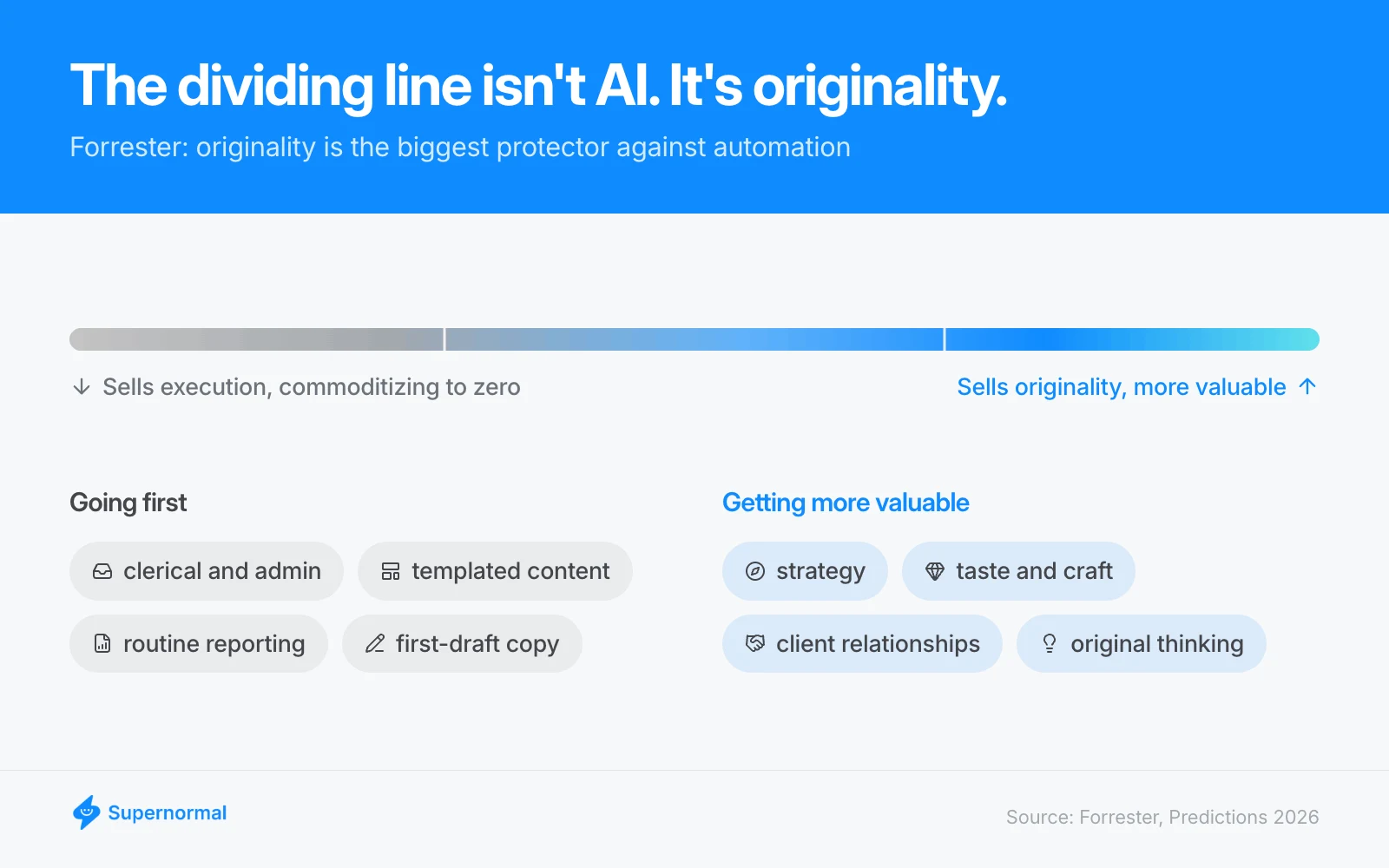
Look closely at the 15% headcount reduction and a pattern appears. Forrester's deepest cuts fall in clerical work (28% of the losses), sales and business development (22%), and market research (18%). The thread connecting them is low originality. This is the work that follows a template, the work AI does first and does cheaply.
The same research points to the flip side. The single biggest factor protecting a role from automation is originality. Everyone frames the divide as "uses AI" against "avoids AI." The divide that actually decides who survives runs between "sells execution" and "sells originality." One of those is getting commoditized to zero. The other is getting more valuable.
The agency leaders we spoke to feel this at the level of individual jobs. Jon Norris of We Are All Connected put it bluntly:
"The junior layer is evaporating. The depressing truth right now is that Claude can do 90% of stuff a junior would have done two years ago. We need agencies, especially big agencies, to keep the talent pipeline going."
Viola Eva of Flow Agency sees the same force pricing out a classic agency product:
"The cost and value of deliverables is falling almost to zero. There is no real value in a hand-made content audit anymore."
This is the part worth sitting with. What's being automated is the billable hour, the work a machine now does in seconds, not the agency itself. Any agency whose business rests on charging for those hours is exposed. Any agency that's quietly moved its value somewhere else is not.
The fork in the road
Here is what makes this moment strange. Two agencies can adopt the exact same tools, the same models, the same subscriptions, and end up in opposite places. The software is identical. The strategy is not.
Anna Moragli of Search Magic drew the line cleanly:
"The winners will be the agencies that position themselves as growth and visibility partners rather than execution vendors."
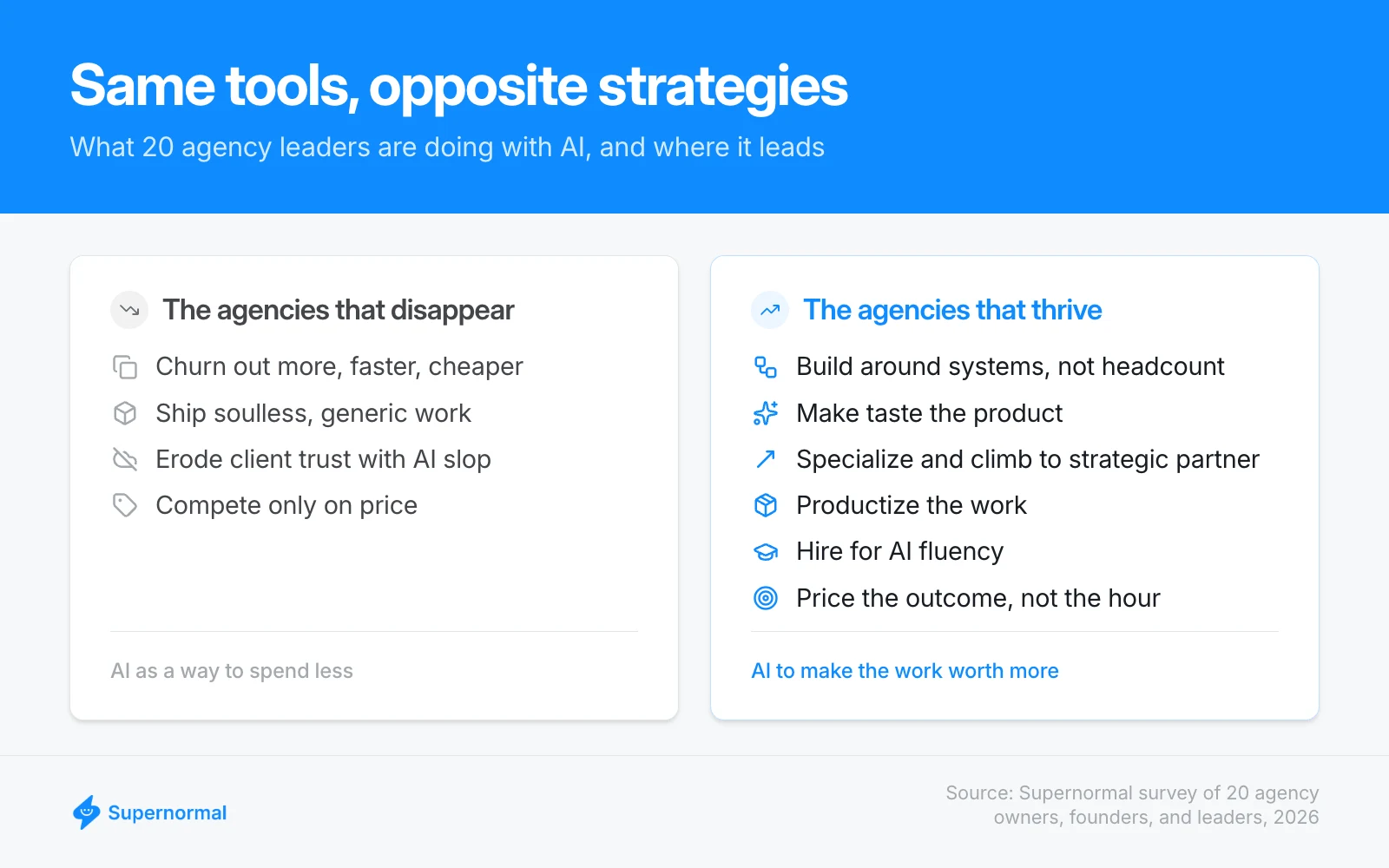
Everything that follows is two strategies running in reverse. One uses AI to do the same work cheaper. The other uses AI to do different work entirely. The first quietly disappears. The second thrives.
The agencies that disappear
The agencies in trouble are not the ones ignoring AI. Often they are the most enthusiastic adopters. They've just pointed the technology at the wrong goal: cutting cost instead of building value. Four moves show up again and again, and every one feels efficient on the way down.
More, faster, cheaper. The first instinct is to use AI to produce more. More content, more outreach, more reports. Peter Emad of SalesCaptain named exactly where that leads:
"A lot of agencies will use AI to create more noise. More content, more outreach, more reports, more generic strategies. But not necessarily better work. The market becomes flooded with average AI-assisted output, and clients start trusting agencies less."
Settling for soulless work. Volume without judgment produces a particular kind of output, and clients can feel it. Paul Fowler of Moat Studio summed up the risk in five words: "That people settle for AI-fueled mediocrity." Jessica Martinez of Mad Fish Digital described the broader spiral:
"It seems to be a race to the bottom right now as far as pricing goes. In a world where anyone can be a vibe coder, 'AI expert', or pump out 1000 pages of content, don't take the human relationship out of the work."
Damaging trust for everyone. Low-effort AI work does not just hurt the agency that ships it. Heather Hamilton of Well Optimized SEO worries about the wider cost:
"AI has made it easy to spin up an agency overnight, and a lot of those shops are focused on revenue instead of results."
Racing in-house clients to the bottom. When the pitch is just speed and price, clients reasonably wonder why they need an agency at all. Stephen Vernon of Base Hit Marketing expects a painful middle period:
"Companies deciding to bring it in house. I believe there will be a period where work becomes sparse as companies try to figure it out themselves, then bounce back as they see the operational efficiencies of working with an agency that has processes for it."
The common tell across all four is the same. Each one treats AI as a way to spend less. None of them makes the work worth more.
The agencies that thrive
The agencies pulling ahead are running the opposite plays. They use AI to remove the low-value work, then pour the reclaimed time into the things clients can't get anywhere else. Six moves came up repeatedly.
Build around systems, not headcount. The thriving agencies are designing themselves differently from the start, often replacing a dozen single-job tools with one AI agent. Peter Emad again:
"I would build systems from day one. Repeatable workflows for research, data, content, outreach, reporting, and client delivery. I would still hire smart people, but make sure the agency isn't dependent on doing everything manually."
Hannah Swinkin of Saint Boswell, five months into building her agency after a decade in-house, sees the fresh start as an advantage:
"I've been able to start with a fresh slate and weave in AI from the get-go. It's set us up for an incredible growth trajectory at an otherwise uncertain time."
Make taste the product. If AI levels content production, the differentiator moves to the thing it can't fake. Tom Livingstone of Measured Branding put the whole thesis in one sentence:
"If AI is the great leveller for content production, then brand and taste will become the differentiator."
Steven de Brueys of WTF SEO is betting clients come back around to it:
"I truly believe customers would rather have a human touch once they realize that most AI text and outputs lack soul and originality."
Specialize, and move up to strategic partner. Generalist execution is the most automatable position there is. The leaders we spoke to are narrowing and climbing at the same time. Rewati Khare of Pepper framed her approach as "hyper-specialization, with the human-in-the-loop approach as the differentiator." Michelle Tansey of Red Queen Marketing sees specialist skillsets becoming more valuable, not less, as commodity work disappears.
Productize the process. Turning repeatable work into a defined product makes output consistent and frees people for the hard parts. Hannah Swinkin again:
"Productizing their processes, so output is more predictable and standardized across teammates. It gives teams more space for the real heavy lifting: strategy and creative thinking."
Hire for the new shape of the team. The roles agencies are paying for have shifted. Michelle Tansey told us her most valuable hire this year was a dedicated automation and systems person. Viola Eva is hiring for "marketing engineering" alongside account management and strategy. Jon Norris wants "AI fluency. Not necessarily experience, but an excitement about the possibilities and a willingness to learn."
Price the outcome, not the hour. This is where the whole shift becomes concrete. If deliverables cost almost nothing to produce, billing by the hour stops making sense. Rewati Khare is moving to "charges based on ROI or business impact rather than hours." Forrester frames the same move at industry scale: agencies pivoting from selling services to selling solutions. The hour was never the value. It was just the easiest thing to measure.
Using AI well means keeping a human on top
There is an obvious objection to all of this. Is "use AI well" not the same advice everyone is already giving? It isn't, and the agency leaders we spoke to are sharper about it than most, because they know exactly where the technology breaks.
Mark Williams-Cook of Candour is clear about the limits: "GenAI still can't be used on things you need to be correct. Multi-steps involving GenAI lead to unacceptably high hallucinations." Jessica Martinez sees the subtler danger:
"Sometimes AI makes things up. It works off assumptions, and assumptions are just that. If you don't know it's an assumption, you take it as truth, which can be dangerous when a specialist doesn't know any better."
Stephen Vernon wants a tool that argues back: "I wish it would play devil's advocate and provide citations for where the pushback comes from. I find answers too agreeable." Hannah Swinkin draws a hard boundary: "We'd never rely on it for strategy, data analysis, or research."
Put those together and the real meaning of "using AI well" comes into focus. The thriving agencies aren't using AI to remove humans from the work. They're using it to move humans up the work, from doing to judging, from producing to deciding. Deploying an agent well turns out to be a management skill more than a technical one: giving it the context, instructions, and feedback to do the job properly. The machine handles the first draft and the grunt work. The human owns the taste, the strategy, and the call on whether it's actually right. That is the whole game, and it is the one thing the losing approach forgets.
What they would build if they were starting today
We asked everyone a final question: if you were starting an agency today, what would you do differently? The answers are the clearest map we have of where this is heading.
Jon Norris would "build the entire stack around connections, interoperable tools, and a data layer accessible from your AI of choice." Anna Moragli would "build it as an AI-native business from day one, scaling through systems and proprietary processes rather than headcount, and niche down from day one." Heather Hamilton would "get clear on our mission and values much earlier, because the agencies that stand out are the ones with a real point of view." Stephen Vernon would "hire experts who create processes and pair them with AI automations." The harder question underneath all of it is which tools actually earn a place, something we work through in our guide on how to choose AI tools for your business.
Notice what none of them said. Not one wished they could produce more, faster, or cheaper. Every answer was about originality, point of view, systems, and human judgment. The agencies that disappear and the agencies that thrive are looking at the same technology. They're just asking it to do opposite jobs.
You can still choose which agency you become. The window for that choice is open right now, and it won't stay open forever.
Where Supernormal fits
The through-line of every thriving agency in our survey is the same: move your people from doing the work to reviewing it, and keep human judgment on top of the AI. That takes a tool built for client work rather than a generic chatbot you have to wrestle into shape prompt after prompt. Supernormal takes notes in your meetings without a bot on the call, then uses that context, along with your emails, documents, and projects, to turn a single prompt into client-ready briefs, decks, proposals, and emails. Your team reviews and refines instead of starting from a blank page. The grunt work goes to the machine. The taste, strategy, and final call stay with you.