

Every agency knows the rhythm. The RFP lands on a Tuesday. The deadline is the following Friday. The account lead calls a kickoff. The team huddles, debates the approach, sketches the pricing, divides the questions. Then the real work starts: drafting, formatting, fact-checking, chasing past work, rewriting the same boilerplate for the fourth time this quarter.
The numbers are blunt. Sales teams spend 20 to 30 percent of their time on RFPs and questionnaires. 10 to 20 percent of RFPs go unanswered every year, and missing even one response per month can cost a team anywhere from $1.2 million to $60 million in annual revenue, depending on deal size. For agencies running on billable hours and tight margins, that loss plays out differently: it shows up as senior strategists writing until midnight, juniors rewriting the same case study for three different pitches, and the work you actually wanted to be doing pushed to next week.
The cost isn't just time. It's the strategic work you didn't start, the pitch you didn't enter, the creative idea that died because nobody had the bandwidth to develop it. RFPs aren't the work. They're the gate to the work. And the gate is consuming the team.
Why RFPs hit agencies harder than most
Most AI tools for RFPs are built for enterprise sales teams responding to vendor selection processes. Agencies have a different problem.
An agency RFP response is a strange document. Most clients ask for similar sections — agency overview, strategic approach, team, past work, methodology, pricing, timeline, references — but every RFP has its own twist. Half of what you need to include lives in your team's heads. The other half is scattered across Slack threads, last quarter's winning proposal, a Google Doc someone updated in March, and the discovery call you ran two weeks ago.
The IP problem compounds it. Agencies build the same answers over and over. The capability statement. The methodology overview. The relevant case study tailored to this specific industry. Every team has its version of the perfect answer to "describe your approach to creative development." Most teams rewrite it from scratch each time, because finding the last good version takes longer than starting fresh.
Then there's the context problem. An RFP response isn't just a description of your services. It's a response to this client's specific needs, surfaced in the discovery call, refined in the review meeting, and shaped by the strategic conversation your senior team had on Friday. The best responses sound like you've already started the work. That voice is impossible to fake with a generic template.
Why generic AI doesn't solve this
If you've tried using ChatGPT or Claude for an RFP response, you know the shape of the problem. You paste in the RFP. You ask for a draft. You get back something competent but generic. It doesn't know your client. It doesn't know your past work. It doesn't know what your team agreed in the review meeting. It doesn't know your pricing logic, your team composition, or which case study is genuinely relevant for this prospect.
So you spend the time you "saved" rewriting the draft. You replace the generic language with your team's voice. You swap out the made-up case studies for real ones. You re-do the pricing because the AI guessed. You strip out the over-confident claims and add back the nuance your account lead would actually use.
The math stops working. Generic AI gives you a first draft in minutes and costs you a day to clean up. That's not a workflow. That's a different way of starting from scratch.
The right AI agent: built on your context
The AI agent that helps you draft an RFP well is the one that already has the context. Your meetings. Your past proposals. Your team's actual approach to the work.
This is the difference between retrieval-first AI tools (which search a knowledge base for pre-approved snippets) and context-aware AI (which uses real conversation, real documents, and real client signal to write something genuinely yours). Both have a place. But for agencies, where the unique IP is the way you think about client problems, the second one wins.
Here's what that workflow looks like.
1. Run the review meeting with Supernormal taking notes
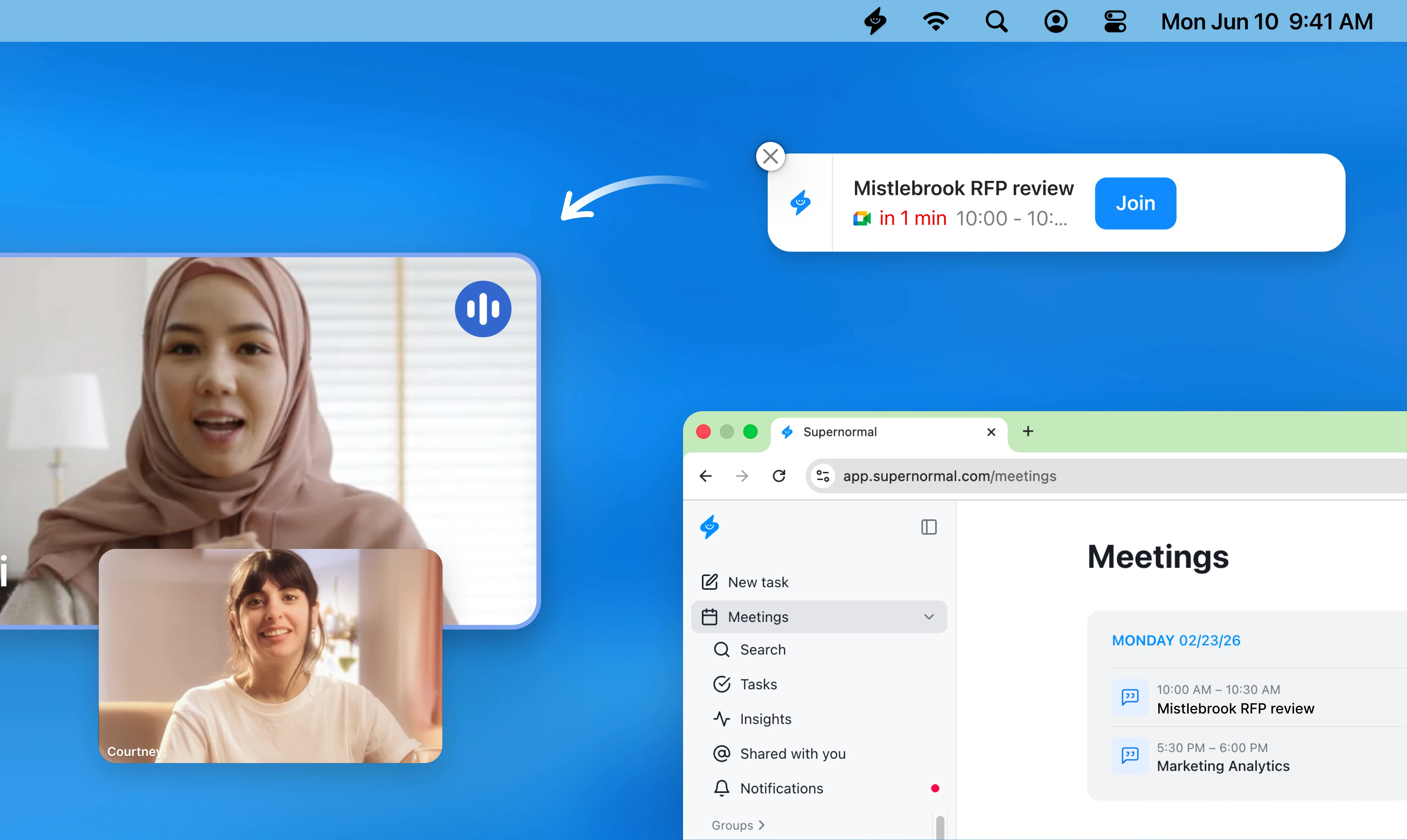
The moment the RFP lands, you call a review. Whoever leads the meeting opens Supernormal's meeting notetaker and runs the call as normal. No bot joins the room. The notetaker captures your team's discussion: which questions you flagged as critical, the approach you agreed to lead with, the pricing logic, the team you want to put forward, the differentiators you want to emphasize.
2. Your meeting notes open automatically in Supernormal
When the call ends, the notes appear in Supernormal in your browser, ready to use. No exporting, no copy-paste. The substance of the response is already on screen.
3. Open the RFP response template
Head to the RFP response template page. The page has its own prompt box with the RFP response structure already attached, so the agent knows to format the output as a proper proposal: agency overview, strategic approach, team, budget, timeline, measurement framework, references.
4. Write your prompt
In the prompt box on the template page, describe what you need: something like "Create an RFP response using this template based on the RFP review call." Hit enter and Supernormal opens a new task, finds the review meeting in your context, and starts drafting. Attach any extra context that matters: past winning proposals, the client's RFP brief, the discovery calls you ran with this prospect six weeks ago.
5. Supernormal generates your RFP response
The draft is a full proposal: agency overview, strategic approach, team, real case studies pulled from your past work, budget breakdown, timeline, measurement framework, references. It isn't generic. It's grounded in your team's actual review meeting and the work your agency has already done. Your team reviews, tightens the language, signs off on the pricing, and submits.
This is the workflow agencies using Supernormal already run. Teams at BBDO, Pinterest, and Thrive Digital use the same meeting-context approach for proposals, briefs, and client communications. The principle is the same: the agent with the most context about your work does the best work.
What to watch for
Speed is the headline. Quality is the catch. A few practical guardrails:
Treat the pricing as a draft, not a decision. Supernormal can pull the pricing logic from your review meeting, but a human commercial lead should sign off before the response goes out. The same applies to legal terms and any custom commitments.
Make sure past responses are still accurate. The case study that won you a 2024 client might describe a service tier you've since changed. Agents work from the context you give them. Old context produces outdated answers.
Match the client's section structure exactly. RFP scoring is rigid. If the client asks for ten sections in a specific order, don't let the agent restructure them. Use the prompt to lock the structure.
Put one person in charge of final quality. The agent does the heavy lift. A named human owns the final read. This is true regardless of which AI you use, and it's especially true for high-stakes pitches.
Where to start
If you're responding to your next RFP this month, the RFP response template is the fastest place to start. It's built specifically for agency RFPs: client-dictated structure, pricing breakdowns, team bios, methodology, references. Add your review meeting and your past work, and the first draft is on screen in moments. For other formats, the full proposal template collection covers project proposals, consulting proposals, and RFP responses in one place.
If you're not yet running your meetings with Supernormal taking notes, that's the step that unlocks the rest. The agent's quality depends on the context it has. Meetings are the context most agencies have most of, and the context they most often lose. Start by running your next RFP review meeting with the notetaker open. Everything else follows.
The agencies that are pulling ahead on RFPs right now aren't the ones with the biggest sales teams or the most polished boilerplate. They're the ones who've figured out how to turn the work they already do, the meetings they already run, into the responses they need to send. That's the agency advantage. It's also what the right AI agent is for.