


Reports of the death of the billable hour have long been exaggerated, but AI will finally make it a thing of the past. AI has broken the correlation between time and value, and every agency leader still pricing services by the hour now has no choice but to act. Clients expect agencies to deliver unprecedented, AI-powered speed and efficiency, yet hourly billing remains the standard pricing strategy for 28% of agencies.
We are now in the era of hourly billing actively working against you. If your team delivers faster thanks to clever use of AI, you earn less, not more. And this is happening while agency margins have already declined to an average of 10% from a golden-era high of 30%, and agency headcount is forecast to fall 15% in 2026, after dropping 8% last year.
Perhaps you know you need to stop billing by the hour, but you're struggling to change things. In this article we'll look at how we got here, what AI changes, and an actionable plan for adapting your pricing and operations so AI improves rather than erodes your margins.
Why agencies bill by the hour
Billing by the hour became standard practice for the pioneers of the agency business model in the mid-20th century. Understanding why a cost-plus approach became the standard helps when thinking through how and why to change things now.
Measurable: The value an agency delivers was hard to quantify accurately, and often arrived over a long period. It made sense to price on something easy to understand and count immediately: hours worked.
Comparable: The agency business has low barriers to entry, so the market is highly competitive and clients like to compare pricing from several providers. A standardized unit of value helped them compare apples to apples.
Protective: When scope is unclear or the client is new, hourly billing protects the agency from underestimating effort. Fixed fees carry more financial risk for a business whose biggest overhead is staff salaries.
Professional services precedent: Many features of the agency business model were copied from legal services, already large and established when agencies started to spring up.
How AI has changed the game
Agencies are under pressure from clients to use AI to deliver more for less, and to use agents to complete creative and operational tasks faster and cheaper. If an agent can mock up 7 campaign ideas in minutes, why would a client pay for hours of a senior creative's time? In reality, the value lies in the past work and references that give the agent context, the prompt a senior creative writes, and the tweaking, filtering, and taste applied once the agent has done its work. Clients are paying for years of experience, institutional expertise, and taste. That value is just harder to quantify in minutes spent on this specific project.
New ways of working with AI undermine all 4 of the original premises for choosing hourly billing. Agencies' impact is now easier to measure and predict, in large part thanks to AI-powered marketing and brand measurement tools. All agencies have equal access to the same models, so everyone is equally incentivized to set a new pricing standard that still makes comparison easy for clients. AI helps agencies learn about clients faster, estimate effort and margin accurately, and prevent scope creep. And other professional services industries, such as Law, are moving away from the billable hour fast as they face the same disruption.
AI is also disrupting agencies' cost bases. Powerful models can be very expensive: Uber blew through its annual budget for Claude Code tokens in 4 months when it incentivized engineers to use the tool as much as possible, and Bryan Catanzaro, VP at Nvidia, has said AI often costs more than employees right now. Where salaries used to be agencies' biggest overhead, you may soon spend more on credits than on payroll.
In the end, most clients don't care whether a task was completed by a human or an agent. They care about the end result, and the price they pay to get there. Your new challenge is to price and package your work in a way that is tied to outcomes, easy for clients to understand and compare, protects your margin from unexpected costs, and won't break your internal operations. Simple, right?
Pricing models to use instead of billable hours
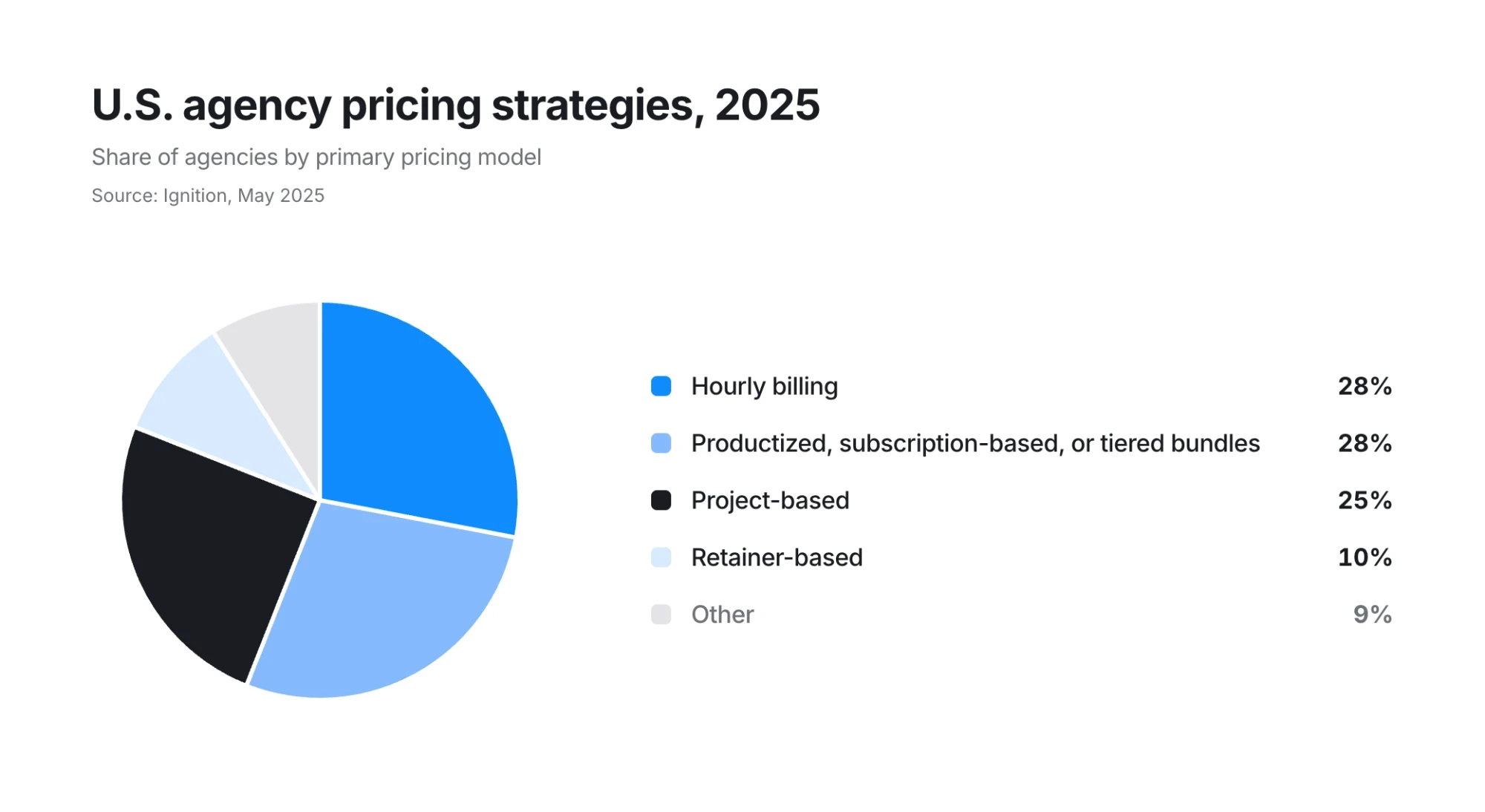
Ignition, a revenue operations platform for agencies, surveyed 273 managers and executives at branding, creative, digital, marketing, PR, social media, and web agencies, and found 4 main pricing models in use: hourly billing, productized (incorporating subscriptions and tiered bundles), project-based, and retainer-based. Here are the pros and cons of the three main alternatives to hourly billing, so you can pick the right one for your agency.
Productized
Packaging up a range of services that achieve a defined outcome for a client, one-off or ongoing, e.g. social media campaign delivery, website maintenance, visual asset design.
Pros: Lends itself to subscription payments, making cashflow more predictable. Clear deliverables and tiered options make it easy for clients to understand what they're getting and flex up or down.
Cons: Unless outcomes and the path to them are tightly defined, scope creep risk is high. You need to know exactly how each offering is delivered, or every "product" ends up looking different and becomes hard to manage consistently.
Project-based
You deliver a one-off, clearly defined project, such as a campaign or digital product build.
Pros: A good path into longer-term work with the client, and often where the most creative, award-winning projects happen because you get to think big.
Cons: Hard to forecast how many you will sell, and because every project differs, hard to price competitively without risking a thin margin if unexpected costs arise.
Retainer-based
A client pays you to take on a pre-defined chunk of their operations on an ongoing basis.
Pros: Predictable cash flow gives you confidence to hire and retain staff. You build deep client relationships and expertise you can sell more services against.
Cons: Successful ongoing work eventually leads to a conversation about bringing it in-house, and retainer work can be repetitive and unlikely to win your agency attention.
4 steps to results-based pricing
So you know you need to move away from billing by the hour, and you have a good idea of which alternative best suits your agency's work. Now the hard part: changing how you sell and deliver. Here are the 4 crucial steps to making the shift stick, and improving your margin in the process.
Step 1: Track every element of the project, including the hours
To see where your most profitable work happens, where margin erodes, and where new AI processes could help, track how the packages you sell line up against the work you deliver. Track staff hours as an input, but also track AI credit usage by project, and gather qualitative feedback from staff and clients as work progresses. Just as importantly, this record becomes your proof of work: a clear account of what was decided, made, and delivered is what lets you charge for results with confidence.
This doesn't have to be complicated. Whatever you already use for logging hours can be repurposed to track credit usage too. File your AI meeting notes by project, then periodically prompt an agent to summarize feedback and flag where pricing and value are misaligned, or where operational issues are brewing. For more on using AI to manage agency projects, check out this playbook.
Step 2: Overhaul your quote-to-cash process
If you're a small agency or freelancer, you may not think you have a quote-to-cash process, but this is just business speak for packaging your services, quoting, managing the contract, invoicing, and getting paid. If you price in billable hours, the entire chain is probably built around them: contract templates structured around hours, a CRM capturing billable hours by project, invoices built on hourly rates.
You can hack around this for a while by converting hours into your new unit of value, but it won't be sustainable. Set up fresh contracts and invoicing templates that reflect your new pricing and packaging, and make sure everyone involved in quote-to-cash understands the change and why it's happening.
Step 3: Standardize and specialize your services
To benefit from selling value rather than hours, you need to understand what your agency is uniquely good at and translate that into repeatable processes and packages, rather than selling whatever you can to whoever you can reach. Hours flex to anything a client asks for; value requires you to think harder about the work you should take on.
Promethean Research found that 84% of digital agencies now position themselves as specialists, with specialist agencies growing 2–3x faster than the industry average. This means saying no to some projects, and perhaps dropping services your team loves. It may be uncomfortable, but specialization and standardization are proven to improve agency performance long-term.
"Repeatable solutions enable outcome-based pricing. They build a body of proof, reducing risk for agencies and increasing credibility for clients."
Brian Kessman, Lodestar Agency Consulting
Step 4: Align staff incentives to client value
If bonuses and promotions are still tied to hours billed, everyone will keep optimizing for them, and any pricing change won't stick. Moving away from the billable hour is a cultural change as much as a strategic one.
Think through AI incentives too. You may want the team using AI as much as possible, but credit leaderboards can drive unintended behavior, as Meta recently discovered. Instead, align team incentives with the same units of value you now sell: a top performer might ship the most deliverables, win repeat work because clients love them, or build a new AI process that lifts margin on every project. Decide which successes you will now track and celebrate.
Practical examples of using AI to drive improved margin
You may have read this far thinking: "All sounds great, but I still have no idea how to implement AI at my agency to deliver the efficiencies everyone seems to be expecting."
First, read this excellent article from Lovable's Head of Growth, Elena Verna. It will help you feel calmer about the pressure. No agency anywhere has totally cracked the AI code (yet).
Next, try these specific and immediately actionable ideas for common agency tasks:
New pricing means a whole new business model
Moving away from billable hours refreshes your agency's business model from top to bottom. That complexity is why so many agencies have avoided the leap, even though clients have been calling for value-based pricing for years. AI is both the spur to push the change through and the tool that eases it, tracking projects and acting as a consulting partner while you land on the right packaging for your agency.
Still have questions? Join our Reddit community to swap tips with other agency leaders steering their companies through the age of the agent.