

Most people do almost no meeting prep. They skim the invite, glance at the attendee list, and hope muscle memory carries them through. This is especially common in fast-paced, client-facing, or cross-functional roles where your day jumps from strategy to status to creative review with almost no pause in between.
And sometimes winging it works, we’ve all been there and gotten lucky. But when your day is stacked with back-to-back calls and constant context switching, momentum slips fast. Meetings drift. Decisions take longer. Follow-ups slip.
Good meeting prep really comes down to knowing why you are walking into the room, what you need from the conversation, and what the other person needs from you. When you get those basics right, the call feels lighter. You make faster decisions. You leave with clarity instead of follow-up chaos. Most people avoid prep because they assume it takes too long. In reality, a few minutes of direction transforms the entire call.
Here are practical ways to prep for the meetings you deal with every week, using steps that take minutes, not hours.
A five‑minute meeting prep checklist you can use for any call
If you have only a few minutes before a call, this is the highest-ROI prep you can do. It sets direction, reduces drift, and gives you a grip on the conversation even if you’re jumping in cold.
Minute 1: Confirm the goal
Write a single sentence that starts with: “This meeting is successful if…”
Minute 2: Skim recent context
Search your email, calendar notes, Slack, or project docs for the latest conversation or update related to this meeting.
Minute 3: Identify your talking points
List three things you need to cover. Not ten. Not six. Three.
Minute 4: Anticipate what they’ll ask
Note the top question or objection you’re likely to hear and prepare a straightforward answer.
Minute 5: Prep the opener
A simple line that sets the direction: “Here’s what I’m hoping we get through today: X, Y, and Z. Does that work for you?”
Copy this checklist into a Google Doc, Notion page or whatever workspace you use, and keep reusing it. It works whether you’re meeting a new stakeholder, reviewing a project, or hashing out next steps with your team.
If you have the day or night before to prep
Add a little depth:
Purpose, People, Process
A lightweight version of the 7Ps framework.
Purpose: what we are trying to achieve.
People: who is here and why they matter.
Process: how we will run the time, in three or four bullets.Context pack
One slide or one page with previous decisions, open risks, and links to source docs. Keep it scannable.Two routes to yes
If your first proposal is blocked, what is the backup that still moves you forward?Pre‑reads
If there are important docs or context people should review before a call, a pre read helps everyone come prepared, not just you. Keep it short, add a three bullet summary at the top, and label it clearly. You can attach it to the invite, drop it in Slack, or email it. Send it 24 hours ahead, if possible.
What people actually use to prep
I recently dropped a Reddit thread which asked, “What tools do you use for meeting prep?” The answers covered the full spectrum. Some people use simple frameworks and one‑page notes. Others use pen and paper. A few rely on caffeine and instinct. And several called out specific tools.
“You can use (Microsoft) Teams to collate historical meetings and emails from each attendee and use it to prepare meeting notes and agendas ahead of time. I keep a running document of stakeholder profiles to feed into Copilot so I can think through their perspectives and wants or needs.” - Commenter, r/ProductManagement
Patterns across the thread, and across most teams:
Simple works. Many keep a running agenda in a Google Doc or Notion. One page per project.
Frameworks help under pressure. A stripped 7Ps or one line purpose keeps calls from drifting.
Tool choice follows habit. Some prep inside the task itself, for example inside ClickUp or Jira.
For tooling, use the simplest tool you will actually open. Then be consistent.
Playbooks for high-impact meetings
Most teams spend their week jumping between strategy reviews, stakeholder check-ins, creative discussions, and recurring rituals like stand-ups or 1:1s. Some meetings are easy to wing, but others fall apart fast without a little structure. These playbooks cover the moments where prep has the highest payoff.
1) High-stakes senior review
Senior reviews move quickly and reward clarity over context. Whether you are presenting to a leadership team, an executive sponsor, or the person who signs off budgets, people decide fast and skim even faster. Most teams over prep detail and under prep direction.
Your aim: a clear decision, not a tour of your work.
How to prep and run the meeting
Step | What to do |
Prep the day before | Two slides only: the decision you need and the three facts that support it. Make a short list of what you will do if the answer is no. Calendar a ten minute pre brief with an ally in the room. |
Run it | Open with your ask, then support it. Keep screen share on the decision slide. Leave a few minutes to confirm owners, dates, and next reporting point. |
Quick script | “Today I am asking for approval to expand the beta by 300 seats. The three reasons are adoption, cost per seat, and support load. If we cannot approve today, I am proposing a two week data extension. Here is the plan either way.” |
If you only do one thing
Write your ask in one sentence so you can deliver it without scrolling or caveats.
You prepped well if
You feel comfortable explaining the core of the meeting without scrolling through notes.
Try to avoid
Saving the ask until the end, over-explaining the background, or trying to cover every detail.
After the meeting
Send a short recap with the decision, owners, and dates. Keep it simple.
2) Difficult or emotionally charged conversation
These are the conversations people procrastinate: misalignment, performance concerns, disagreements, or bad news. When emotions run high, even small misunderstandings land heavily. This is especially true in client relationships, team disputes, or tense project reviews where stakes feel personal.
Without a plan, the conversation spirals or stalls. Prep helps you stay calm, steady, and fair.
"I am an over-prepper - I make lots of notes over a few days to get out what I want to say, and make sure that it is direct but with sensitivity. Lately, I also put it through ChatGPT to see if I can get feedback if it comes off too emotional and therefore takes away from my points I want to make." - CX Manager, B2B SaaS
Your aim: protect relationships, surface facts, agree on one next step.
How to prep and run the meeting
Step | What to do |
Prep | Write a neutral sentence that describes the issue without blame. List three facts and two feelings you have seen on each side. Decide your boundary, for example, “We cannot ship without security sign off.” |
Run it | Start with the shared goal. Ask permission to suggest a process. Use short turns. Reflect back what you heard. End with one clear next step and a follow up time. |
Phrases that help | “Here is what I am observing and why it matters.” “What is the smallest step we can agree to today?” “Let me say back what I heard to check I have it right.” |
If you only do one thing
Write one neutral sentence, a statement of fact over emotion..
You prepped well if
You can describe the issue in a way that feels fair to both sides.
Try to avoid
Jumping into solutions too fast, debating interpretations, or reacting to tone instead of content.
After the meeting
Send a short, factual recap of what you both agreed.
3) Sales or investor update
These calls hinge on confidence and direction. Whether it is a pitch to a prospective client, a renewal, or an investor update, people want a clean narrative: where things stand, what is working, what is not, and what you need from them. Anything scattered reduces trust.
Your aim: build trust and secure a specific commitment.
How to prep and run the meeting
Step | What to do |
Prep | One page with a timeline, three metrics, the story behind them, and the ask. Make a short list of likely questions and clear answers. |
Run it | Start with the outcome you want, then progress, then obstacles, then the ask. Share a draft email or next step they can approve or forward. |
Quick script | “We are on track for the milestone due on the 30th. Two risks remain. If you are comfortable with the plan, the next step is an introduction to the data team. I drafted a note you can send. Can I drop it in chat now.” |
If you only do one thing
Write your ask clearly enough that you do not have to improvise it.
You prepped well if
You know the exact action or commitment you want before the call starts.
Try to avoid
Diving straight into metrics, softening risks, or ending without a next step.
After the meeting
Send the draft you referenced. Make it easy for them to forward or approve.
4) Client or stakeholder check-in
These meetings get messy fast. Some stakeholders come without an agenda, and internal teams often over-explain or context dump. The result is a call where everyone talks, but nothing moves forward. Prep keeps the conversation focused and protects the relationship.
Your aim: leave with a shared decision or clear next step.
How to prep and run the meeting
Step | What to do |
Prep | One page with the last milestone, what is in progress, risks or asks, and what you need from them. |
Run it | Start by stating the goal for the call. Share progress in three clear bullets. Confirm next steps with owners and dates before you close. |
Bonus tip | Keep updates short. Ask: “Before we jump in, is there anything specific you want to cover today?” |
If you only do one thing
Decide the one outcome you want them to leave with.
You prepped well if
You can explain progress and the ask in under a minute.
Try to avoid
Letting the call turn into a broad status update, assuming they remember last week’s decisions, or presenting too much detail too early.
After the meeting
Send a short recap the stakeholder can forward internally without edits.
5) Cross functional working session
These sessions can get messy, fast. Different priorities, different roles, and too many ideas competing for airtime. Without structure, the meeting expands instead of converging. Prep gives the group rails to run on so you leave with decisions, not a larger to-do list.
Your aim: leave with named owners and dates.
How to prep and run the meeting
Step | What to do |
Prep | Create a simple outline with three sections: Decisions, Open Questions, and Parking Lot. Add rough times to each section. |
Run it | Assign a note taker at the start. Use the parking lot to keep the conversation on track. End with a one minute recap while everyone is still in the context. |
Bonus tip | Start by saying, “Here is what we need to decide today,” then stick to it. |
If you only do one thing
Pick the two decisions that must be made today. Everything else goes in the parking lot.
You prepped well if
You can describe what “done” looks like for the meeting before it starts.
Try to avoid
Trying to solve everything live, letting side conversations take over, or skipping the recap.
After the meeting
Send notes quickly with decisions, owners, dates, and anything moved to the parking lot.
Templates you can paste into your notes
If you don’t have time or energy to build your own structure right now, start with something simple you can reuse.
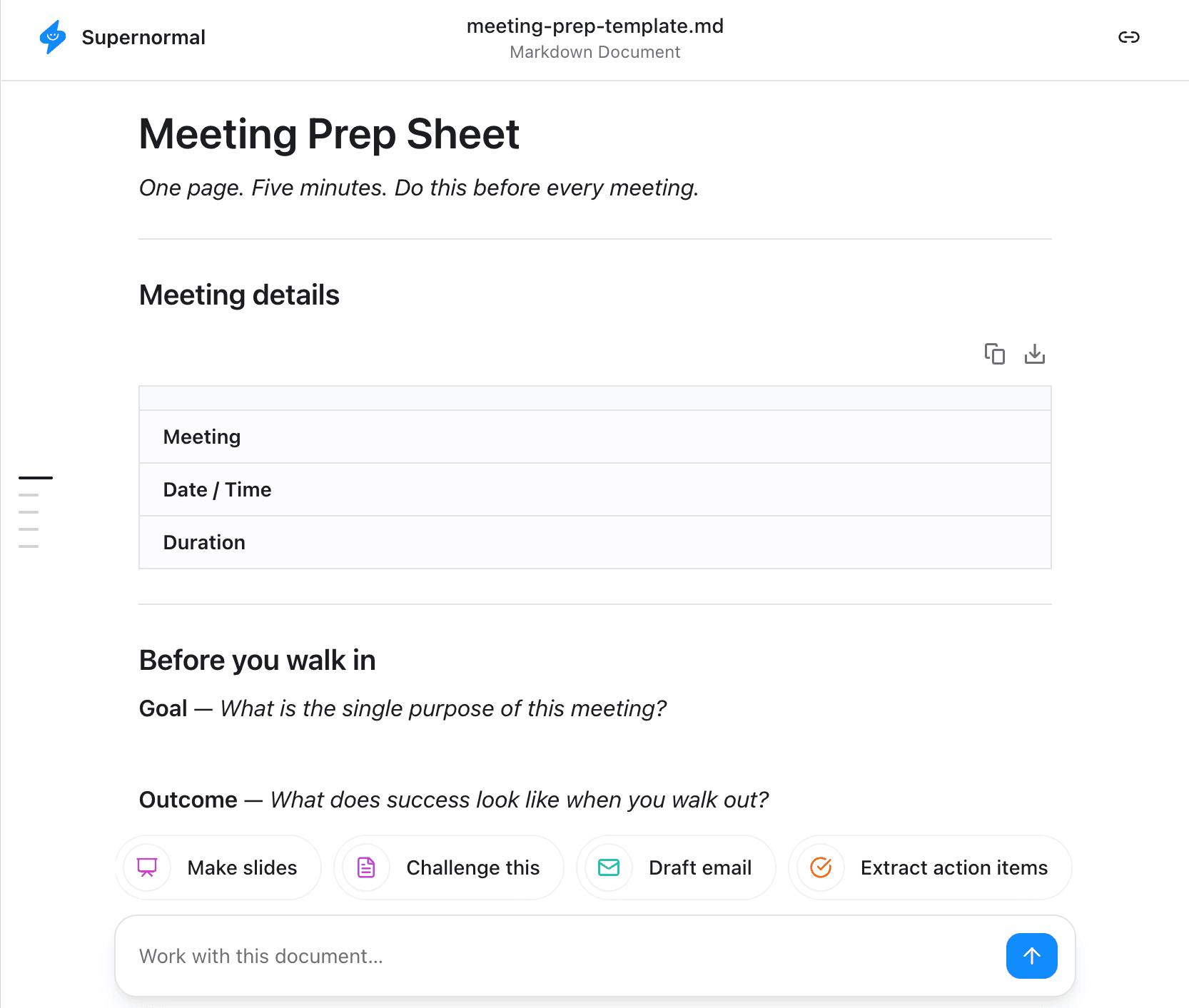
One page prep sheet
Paste the following into a document, or add your context to this template here.
Goal:
Outcome I want by the end:
Top two questions:
Attendees and roles:
Last decision and link:
Risks I see:
Close script:
For example, your goal might be ‘Align on the Q1 scope,’ and your close script might be, ‘Before we wrap, here’s the decision I’d like us to confirm today.’
Simple agenda
Welcome and goal, 2 minutes
Topic A, 8 minutes
Topic B, 8 minutes
Decisions and owners, 5 minutes
Next steps and timing, 2 minutes
Light automation that actually helps
You do not need a heavy system to prepare well, but a few tools can remove busywork. Calendar add ons and AI assistants can pull attendee bios, grab recent email threads, find the last doc you used, and draft talking points from past notes.
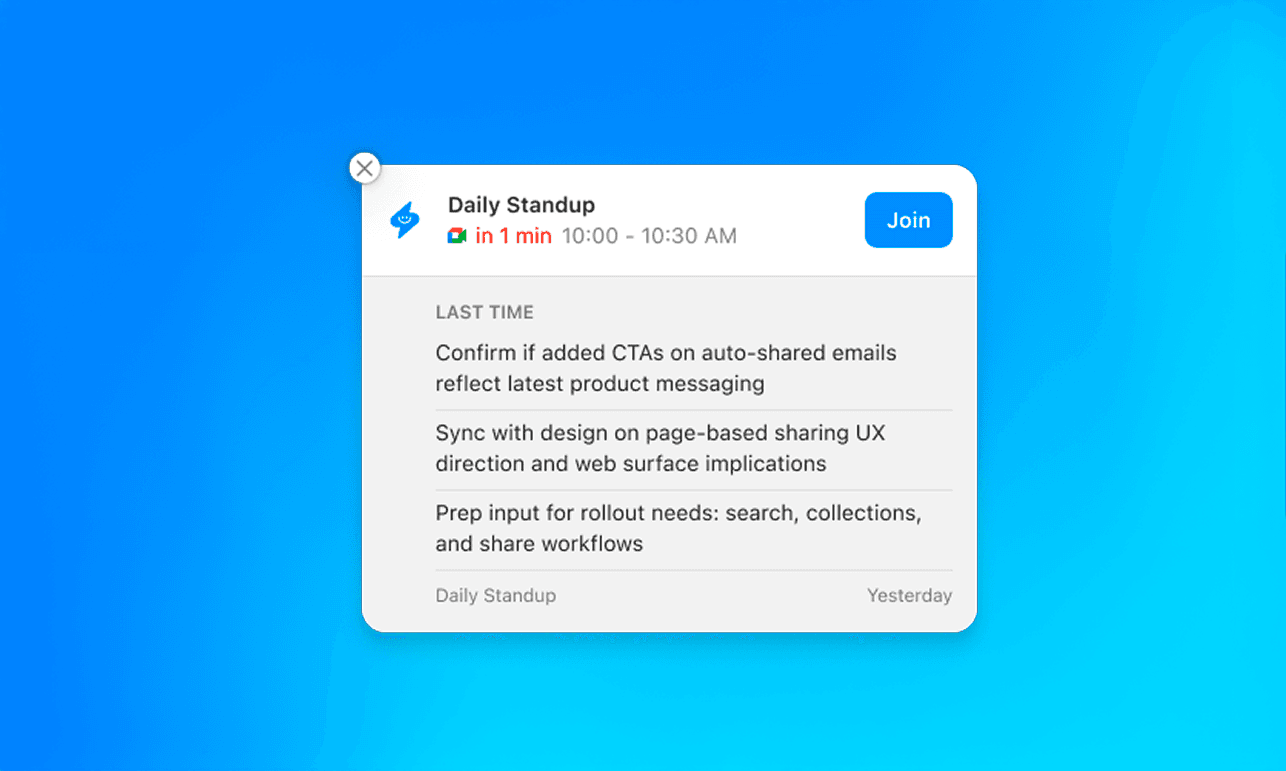
When you join a recurring meeting, Supernormal shows three key points from your last call. That quick refresh means you walk in ready, not scrambling to remember what happened last week.
Before you click ‘Join’
Those last few seconds before you join a call are where most meetings are won or lost. A quick reset helps you show up clear, steady, and ready to lead the conversation instead of reacting to it.
Read your one line goal out loud.
Check your ask, owner, and date are clear.
Open your recap script.
Put links in a single note so you can paste fast.
Mute notifications.
And when the meeting ends? If you’ve used Supernormal, you’ll have all the decisions, action items, and context to get the work done.